


Hooray! Challenging the Myths of Autism won a second award: The Nonfiction Book Awards Silver Winner! The award reviewers commented: “Well written book! [It provides] a lot of practical easy to understand options for working with and treating children with autism…Engaging, simply stated, very impactful message.” Even though it was published several years ago […]
Blog
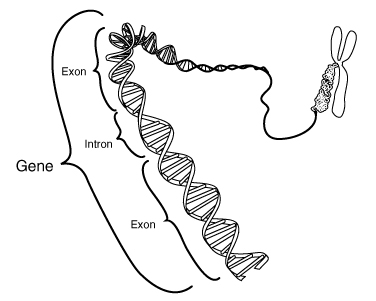
“SickKids Hospital scientists figure out formula for predicting autism.” June, 2014: An international group of genetic researchers including Toronto SickKids Hospital top-gun Dr. Stephen Scherer have pushed us one step closer to understanding the genetic underpinnings of Autism Spectrum Disorder (ASD). Previously, years ago, they discovered about one-hundred genes that […]
While April is the world-wide Autism Awareness month, in Canada October is too. And to help kick-off this important month to rise greater public awareness of this increasing diagnosis, three Canadian authors representing their latest books on autism will present a panel to discuss their ideas on autism and autism awareness. Parents, professionals and the […]
Play and recreation has many more benefits than just ‘down time’ for children with autism. This weekend, a wonderful group of professional surfers and paddle boarders from California and Hawaii and Toronto gathered at Woodbine Beach in Toronto to provide a surfing experience to dozens of local children with autism. The organization is called Surfers […]
I had a laugh giving Jerry Seinfeld a copy of my book Challenging the Myths of Autism! At the Toronto East General Hospital’s Premier fundraising gala of 2012 , MC’d by Will Arnett, Seinfeld kept us all laughing- what a spectacular evening! Both were generous in giving their time and talent to raise funds for […]
Last month my book Challenging the Myths of Autism won the 2012 INTERNATIONAL BOOK AWARD for Best Parent Resource! This honour is bringing more attention to the book and encouraging parents and professionals to get a copy and to join the movement to challenge the myths. Sadly there are still so many negative stereotypes that […]

Last week I was training a small group of therapists who work with a cute and lively five-year-old named Marty in her family’s home. After two years in an intensive home-based treatment program, Marty will start senior kindergarten this fall and we all felt enthusiastic that her new teacher Ms. Kay had joined us to […]
You’re invited to click and play this Beatles video to enjoy music while you read the article on love and autism below. http://www.youtube.com/watch?v=ZXL08IoNKiE Love, Love, Love…Love is all you need”, John Lennon famously sang these words to the world in the ‘60s. The message is as relevant today as then, but for some reason we […]

A commonly believed and repeated myth is that people with autism lack imagination. Autistic children don’t play with toys or people like their neurotypical peers do. There’s no argument about this fact. Due in large part to their communication challenges, most children with autism are unable to show or talk about their imagination. It is […]

Current research supports the idea that the factors contributing to the behaviour, communication and learning challenges of people on the autism spectrum are multifaceted; Therefore, I believe, treatment should be multi-faceted as well. Treatments such as Applied Behavioural Analysis and special diets are important and can contribute to positive development but they are simply not […]

