


A commonly believed and repeated myth is that people with autism lack imagination.
 By Kevin Schwoyer, Autisitc, 5 yrs old
Autistic children don’t play with toys or people like their neurotypical peers do. There’s no argument about this fact. Due in large part to their communication challenges, most children with autism are unable to show or talk about their imagination. It is not as obvious or evident as with most kids.
However, just because they don’t play like others do and just because they may not be able to verbally communicate does not mean they don’t have imaginations.
As I discuss in my book Challenging the Myths of Autism, I believe that the myth that autistic children don’t have an imagination likely began in 1979 when a well respected and important autism researcher Lorna Wing and her colleague Judith Gould popularized the idea that lack of imagination should be one of three main criteria for diagnosing the disorder. Their ideas were quickly adopted by the medical community and most professionals. People added their own spin on what exactly they believed lacking imagination meant. Soon enough it was used to explain a whole range of behaviours including repetitious rituals and unusual pretend play.
The negative impact this has had is that we often limit opportunities for these children to be creative (since they don’t have imagination anyways) and we may fail to recognize their unique imaginations (since they don’t have one in the first place, so the myth goes).
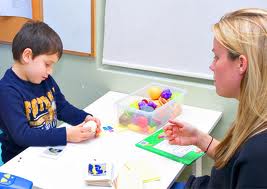 No imagination required
Instead of opportunities like most children have to practice, explore, and express their growing imaginations through play, autistic students are most often subjected to rote learning drills.
In pretend play children can imagine being different characters, flying in a rocket ship, or having super powers. But curriculum for children with autism rarely includes open-ended pretend play. Instead they are taught the ‘correct way’ to roll a toy car across the floor. Using Play-Do, building blocks, or crayons, most children have the chance to explore creating new kinds of creatures like
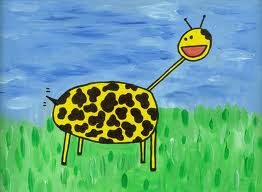 Time for imagining
elephants with 6 legs, or houses with swimming pools in the bedroom, or ice cream in the shape of spaghetti. Kids can think of almost anything! This kind of play is unstructured and we praise innovation and silly creations. In contrast, many autistic students are taught or even only allowed to sing songs with the “right words’, to draw houses with
square windows, and to build only recognizable things with leggo. When they create new or unusual drawings or seemingly random patterns with blocks that we don’t immediately recognize, instead of praising their innovation or allowing some silliness, we work even harder to ensure they learn how to draw the picture ‘appropriately’ and build the block tower ‘correctly.’ Ironically, the children that might benefit the most from open-ended imaginary play are the ones we impose the most structure on!
It turns out that Lorna Wing had meant something more specific than ‘lack of
imagination.’ She might have more accurately written “social imagination”. In an interview with Adam Feinstein she clarified that “Autistic children do have imagination, but it is not social.” To be even clearer, she is referring to the concept that autistic people have a hard time taking (imagining) other people’s perspective and showing empathy (imagining how other people might be feeling). Despite social challenges, we need to talk about the autistic imagination. Unfortunately, by the time the interview was published in 2010, the myth had already become well rooted in the field of autism treatment and in the general public.
- You can help push the myth into extinction by providing lots of imaginary and pretend-play opportunities for a child with autism.
- Keep your eyes open for their own unique expressions of creativity.
- Make sure to praise new forms, innovations, and unusual designs as much as you would for any child.
- Don’t be afraid to reinforce imagination and creativity as much as reinforcing appropriate and conventional ways to play.
If you have your own story of imagination in a child with autism, you are invited to join the conversation on this myths of autism at www.ChallengeTheMyths.com.


{ 2 comments… read them below or add one }
Hello, my son clearly is autistic. He hits on every mark in the “symptoms” only he is on the higher scale. I have debated for a year now on whether I should get an official diagnosis due to his ability to imaginary play. I noticed when he turned 2 that he was not your typical 2 year old when he kept playing with his baby toys still (and not playing with them properly).. I am a dedicated preschool teacher (I am a stay at home mom, I still say “am” because I teach my son and daughter everyday!) I know what is age appropriate and I know the ability of children his age. So, when I saw him kinda “stuck” I made it a point to do circle time with him everyday and make aside 30 minutes of my time to teach him to “think outside the box”. I believe it has helped tremendously! He is now three and can pick up a straw and say “My snake!” or if I sit with him he will play with me and follow my lead until his mind finally takes him somewhere else. Though his play is mostly a year of scripting me, he can still spot things that are different but similar to what I have taught him. Most of his play is repetitive, he manly lines them up or puts them in groups but I have at least opened his mind up to where he can make each of his toy story characters fly like Buzz Lightyear, one at a time, into a line. I am proud of him and hope that they can still see his struggles and not turn him away to be diagnosed. I fear with all I have taught him he will be turned away and I can only do so much therapy on my own as a teacher/mom. Wish me luck, I am taking this article in with me to his appointment. Thank you for having something I can fall back on.
I appreciate that you have written this post. I am doing some research for a college paper about Empathy and Autism. At this present moment, for the sake of an assignment, I am researching about imagination and autism. Most of the ‘research’ says that autistic children don’t have a lot of imaginative abilities…. when they’re in the presence of intimidating researchers asked to draw something that may or not may appeal to them. I agree that autistic children DO have imaginations. Since they’re clearly wired differently in the brain, their imaginations must come out in different ways, with their own twists, whirls, and kinks.
{ 1 trackback }